It is the new year. You begin scanning your email and see that you have been assigned your annual training by your company — you cannot stifle the sense of dread as you contemplate another mind-numbing training. It does not have to be this way.
Research on adult learning has shown us the path to presenting the most effective training.1 Distilled down, we know that blending visual imagery, voice-over, reading, and interactive training provides the best results for e-learning.2 In this article, we will be exploring the ways in which adults learn. We will focus on the role of visual imagery and other elements in improving recall. We will discuss how pre-testing can generate productivity savings for your company and increase employee engagement. Finally, we will map all of this against the DOJ's views on training and ways such training can be specifically designed to increase its impact.
How Do We Learn?
People generally remember 10% of what they read, 20% of what they hear, 30% of what they see, and 50% of what they hear and see.3 This is not to say that we all learn the same way — far from it. There are three primary types of learners: auditory learners, kinesthetic learners, and visual learners.4
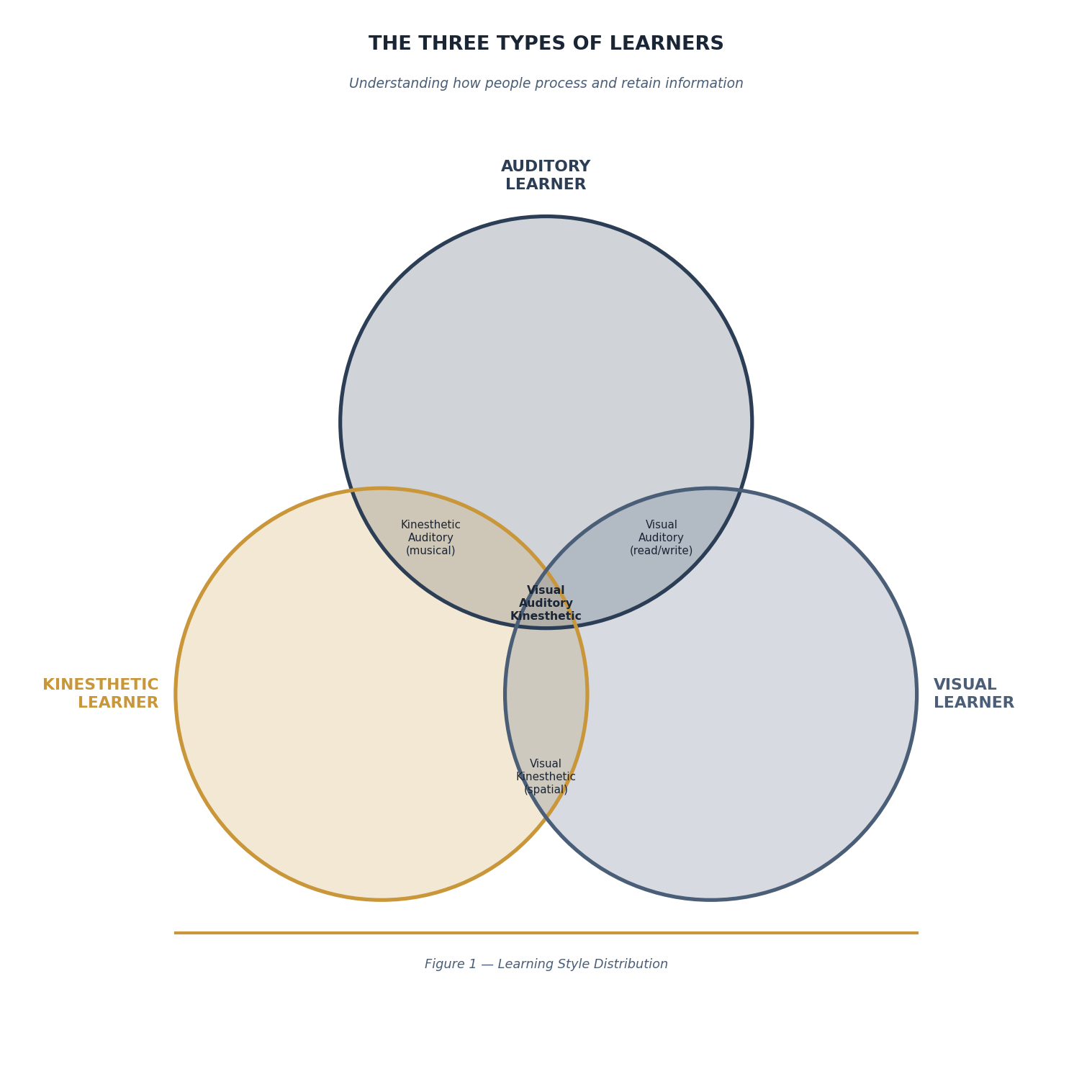
To give an audience the greatest odds of retaining material, present the information in multiple formats and engage all parts of the brain strategically. What is remarkable about this fact is that "90% of information transmitted to the brain is visual and visuals are processed 60,000 times faster than text."5 Our brains actually view text as tiny pictures. Each individual letter is its own picture. These "letter pictures" are combined into words that we then convert to concepts. Put another way, text is one of the most inefficient ways to transmit information.
Not All Images Are Created Equal
Compelling visuals coupled with text and speech can close the gap.6 Merely throwing clip art into a presentation will not accomplish this goal.7 Working to find the right image to match with a concept is a science in and of itself. For example, say you are trying to convey that there are a number of new regulations that will be affecting your company. Showing your audience a picture of stacked law books is too literal; it will not create the type of left brain/right brain connection we are aiming for in the learning process.8 Instead, try using the picture of a wave; this image causes the audience to reach slightly, thinking about the coming "wave" of regulations.9 This stretch is what causes the learning to imprint, facilitating recall.10

Whether used in training or just in speaking to a group, presentation software has become ubiquitous, but sadly it has become a repository for a lot of poor communication hygiene.11 Many presentations veer toward the dreaded "deck speak" — the habit of using a presentation deck to spell out lengthy, complicated information that would be more appropriate in a written document.12 Further, many speakers use the software as a crutch, rather than a spotlight, significantly distracting the audience.13 Poor use of presentation software often distracts and frustrates the audience: the result is a fragment of both being received with less retention.14
Respecting Your Audience
In e-learning compliance courses, there must be respect for the recipient. This can begin with a pre-test.15 Allowing someone to demonstrate subject matter mastery and test out of a course is beneficial to both the recipient and the company. Recipients feel their time is valued and respected, and the company can be assured that the topic is understood and that it will not lose productive hours.
Consider one example that illustrates this point:
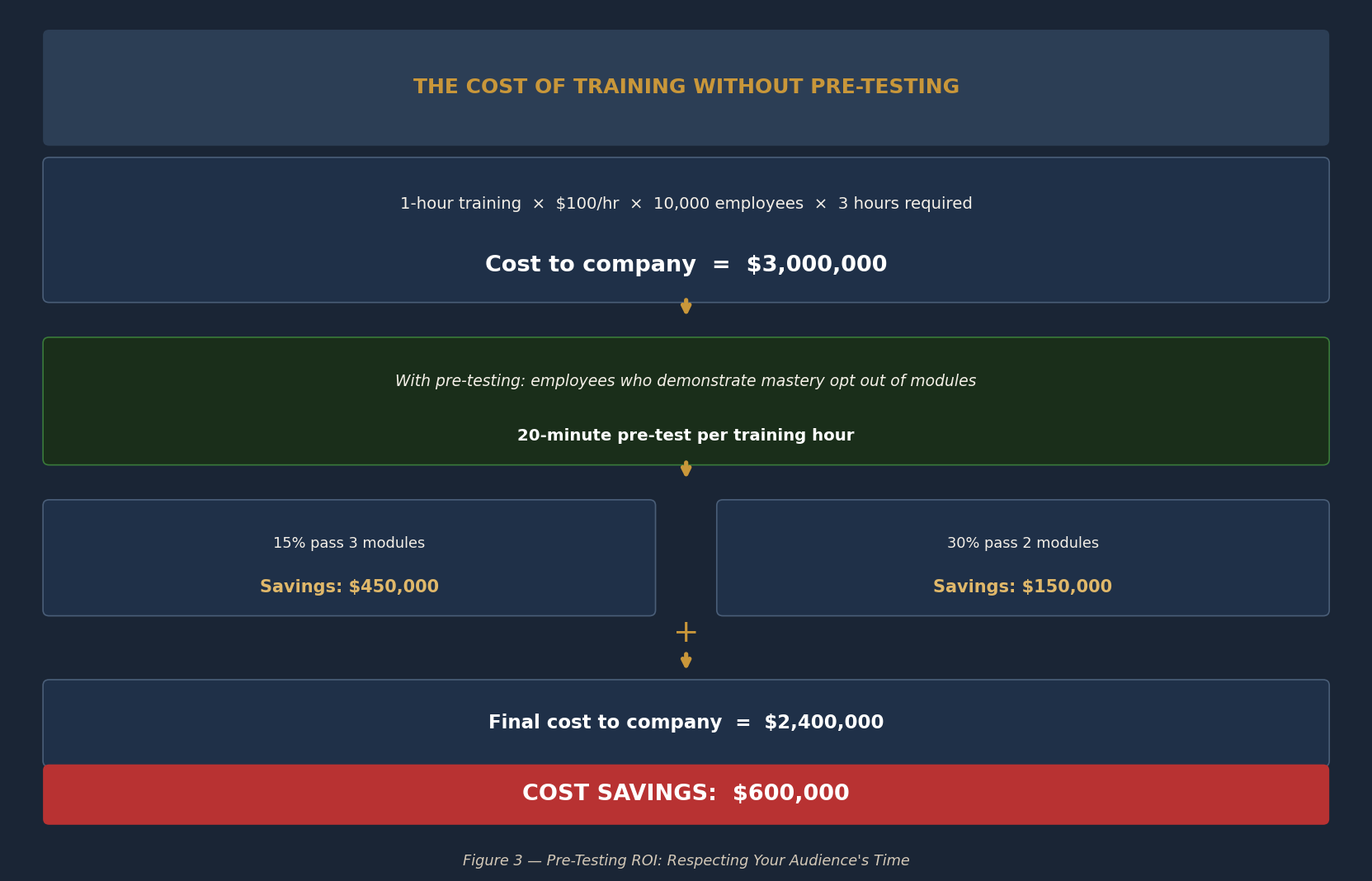
When we are considering pre-testing, we are not talking about, for instance, three simple true/false questions. Such a test should be written at a high Flesch-Kincaid readability level16 that probes whether the recipient understands the nuances of the topic accurately and consistently.17 This is the kind of pre-testing that respects the person being tested and the company.
DOJ's Guidance on Effective Training
Companies do training for a variety of reasons, not the least of which is as part of a defense strategy. Specifically, they want credit for telling their employees and partners what the legal expectations are. This is reinforced by the DOJ's own focus. In June 2020, the DOJ released its Evaluation of Corporate Compliance Programs, which outlined the factors the Department uses to evaluate training programs.
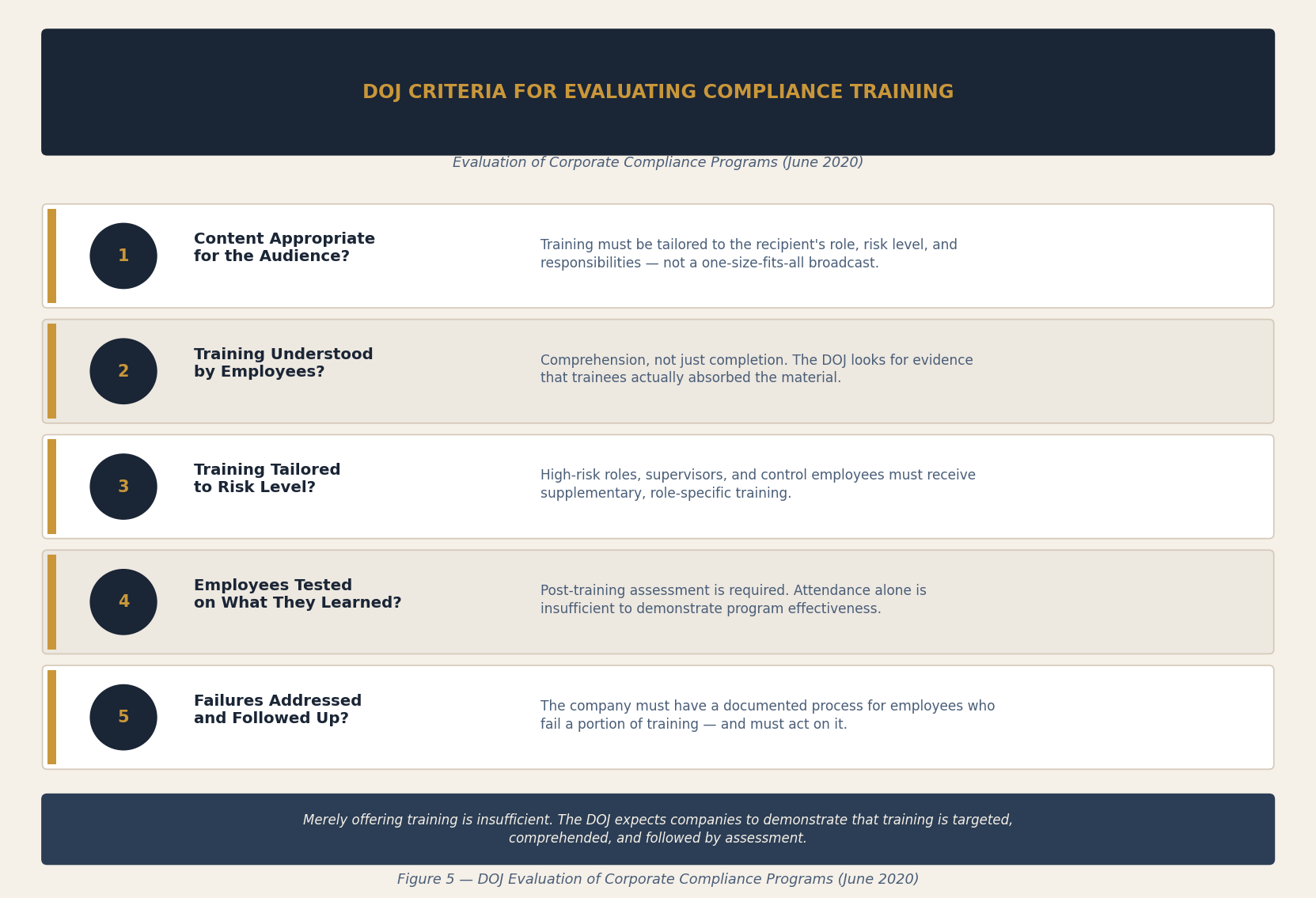
This list highlights that merely offering training is insufficient. It also pairs with the DOJ's focus on data analytics.18 The DOJ wants a company to be able to demonstrate that its training is targeted and that the trainees fully understand what they were trained in.19 Therefore, the content needs to be accurate and compelling and there needs to be a follow-up assessment.20
"Merely offering training is insufficient. The DOJ expects companies to demonstrate that training is targeted, comprehended, and followed by assessment."
— DOJ, Evaluation of Corporate Compliance Programs (2020)It Is Not "One and Done"
Even if recipients can demonstrate understanding at a point in time, how do they maintain that level of comprehension until they are next asked to take a test on that topic? This is where the "forgetting curve" comes into the analysis. Not surprisingly, as time passes, recipients forget.21 However, this can be addressed and even rectified.
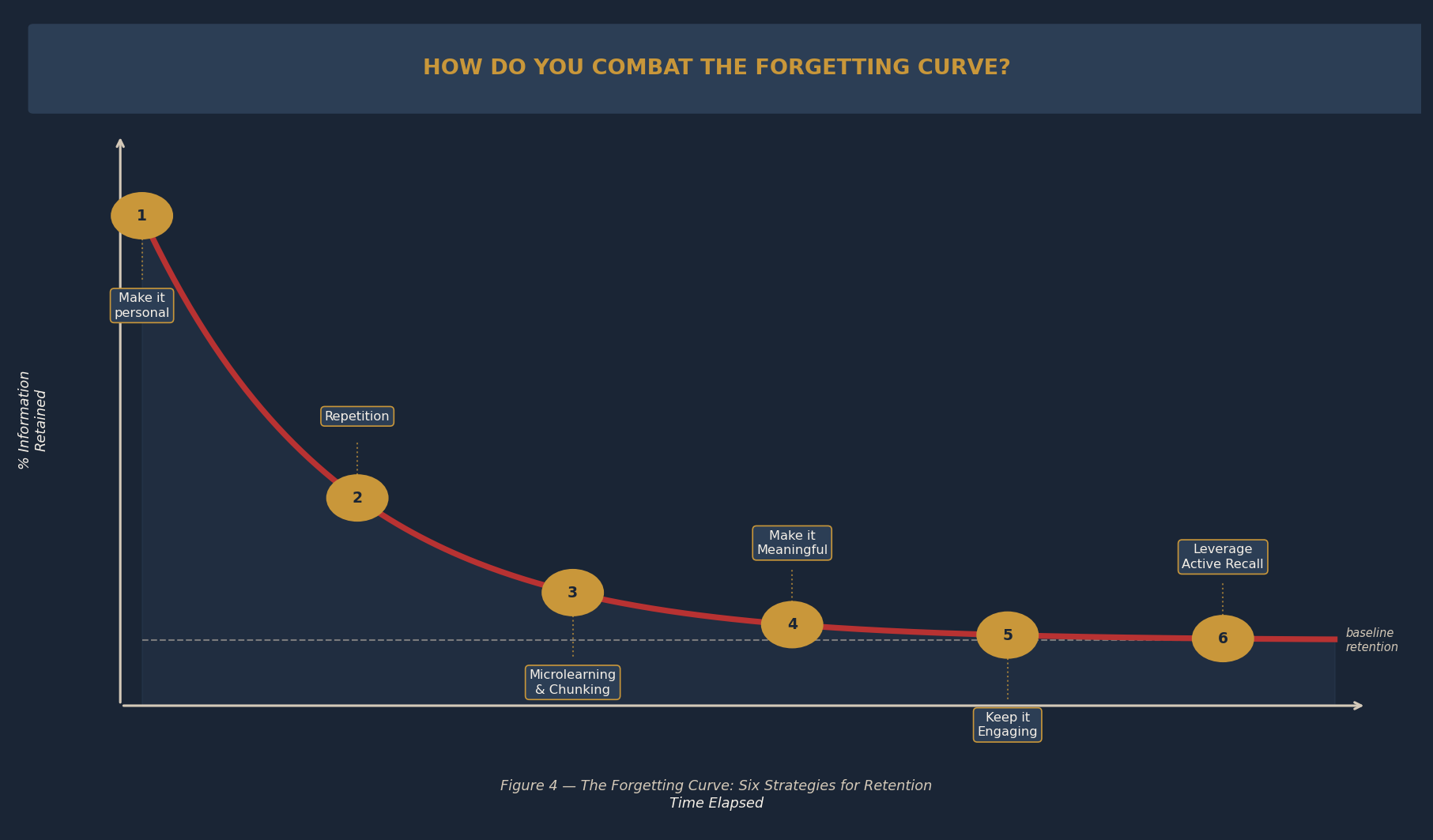
Six strategies have emerged from the research as the most effective interventions against the forgetting curve:
If a grocery chain is training on sexual harassment and all of the narrative examples relate to a fictitious semiconductor office environment, its effectiveness would be questionable at best. Tailoring training to the company's industry and commercial model pays dividends in recipients being able to apply the training to their working circumstances.
The general rule is to use as many modes of communication as possible. The information should of course be in the training, but should subsequently be reinforced across the spectrum — for instance through newsletters, emails, small group discussions, and "from the podium" exhortations.
The research is in flux on this. The prevailing wisdom has been to provide training that is short and frequent. Rather than giving an hour on antitrust training, it is thought to be better to offer four 15-minute courses. However, new research suggests that people can maintain their focus on new information and retain it if the message is presented in a dynamic, interactive, and compelling way.
The training has to connect to the basic idea of "why does this matter to me?" Part of this is being careful to target your training. It may seem easy to require the entire employee population to take a particular course — but that can lead to waste and even create a cynical work environment. If an employee in accounting receives training on how to properly lift a heavy box, the company risks losing its entire audience and, even more critically, de-valuing the rest of its courses.
There is a major revolution in "gamification" of training. This can be effective in certain situations, but should not be overused. Including interactive elements in training can be very helpful. This does not mean hitting the "next" button — that is not really a satisfying interaction in the learning process. But even something as simple as asking the recipient to click on a box to learn more about the topic can make a positive, engaging difference.
Short, reinforcing quizzes incorporated into the training can assist in the imprinting of messages. It is easy to zone out in a lecture and nod that you understand the math lesson. It is quite another thing to show your work in solving an analytic continuation of the factorial function.
This Is Not the End
A good compliance and training program will include training metrics to evaluate its effectiveness. Some common training metrics22 are as follows:
- Trace the number of attempts taken to take the post-training test23
- Track employee performance post training
- Calculate the ROI24
- Measure employee engagement
- Collect feedback on the training
This combination of metrics should feed into a continuous improvement model whereby results inform the upcoming training calendar for frequency, length, and topics.
Finally, it is important to emphasize that training as a "check-the-box" exercise is a waste of precious resources. Being strategic and thoughtful about tailored training pays measurable dividends. Freshen your color palette and begin painting that picture for your teams.
This article is intended for informational purposes only and does not constitute legal advice. For guidance specific to your organization's compliance program, consult qualified legal counsel.
- Dr. P. Sri Jothi and Ms. Aswini Chitra, "An Analytical Study on the Effectiveness of Multimedia in E-Learning," International Journal of Media, Journalism and Mass Communications Vol. 1, Issue 1 (2015): 1–7.
- Id.
- Snejana Dineva, "The importance of visualization in e-learning courses," The 14th International Conference on Virtual Learning, 179 (2019).
- 65% of the population is primarily visual learners.
- Dineva, "The importance of visualization in e-learning courses," 179–180.
- John Medina, "Brain Rules," Brain Rules. Last accessed February 10, 2021, https://brainrules.net/vision.
- Haig Kouyoumdjian Ph.D., "Learning through Visuals," Psychology Today, July 20, 2012, https://www.psychologytoday.com/us/blog/get-psyched/201207/learning-through-visuals.
- Kai Tomboc, "Text vs. Images: Which Content Format is Effective," Easelly, May 30, 2019, https://www.easel.ly/blog/text-vs-images-which-content-format-effective.
- Linda Kreger Silverman, Ph.D., "Why Visual Learning and Teaching?" Insight Resources, April 26, 2019, https://www.insightresources.org/2019/04/26/why-visual-learning-and-teaching/.
- Tim Elmore Ph.D., "In Other Words," Growing Leaders, April 2, 2019, https://growingleaders.com/blog/why-is-teaching-with-images-so-effective-part-1/.
- Id.
- Allan M Jones (2003) The use and abuse of PowerPoint in Teaching and Learning in the Life Sciences: A Personal Overview. Bioscience Education, 2:1, 1–13, DOI: 10.3108/beej.2003.02000004.
- Robert Harris, "PowerPoint Tips and Techniques," Virtual Salt, October 30, 2020, https://www.virtualsalt.com/powerpoint.htm.
- Id.
- K.S. Chilwant, "Comparison of two teaching methods, structured interactive lectures and conventional lectures," Biomedical Research 23(3), (2012) 364.
- The Flesch-Kincaid readability tests are designed to indicate how difficult a passage in English is to understand. There are two tests: the Flesch Reading-Ease and the Flesch-Kincaid Grade Level. Although they use the same core measures (word length and sentence length), they have different weighting factors. The results of the two tests correlate approximately inversely: a text with a comparatively high score on the Reading Ease test should have a lower score on the Grade-Level test.
- Dennis M. Finnegan, "E-Learning Success: Readability versus Reading Skill," International Journal of Instructional Technology and Distance Learning, October 2006, https://www.itdl.org/Journal/Oct_06/article04.htm.
- U.S. Department of Justice, Criminal Division, Evaluation of Corporate Compliance Programs, June 2020, https://www.justice.gov/criminal-fraud/page/file/937501/download.
- Id.
- Id.
- Harry Cloke, "What is the Forgetting Curve (and How do you combat it)?," eLearning Industry, March 30, 2018, https://elearningindustry.com/forgetting-curve-combat.
- Andriotis, "How to Use Training Metrics to Measure eLearning Effectiveness."
- A recipient should only be permitted one attempt at a pre-test. Further, if recipients know they do not know the material, they should be provided the opportunity to skip the pre-test.
- Return on Investment.